
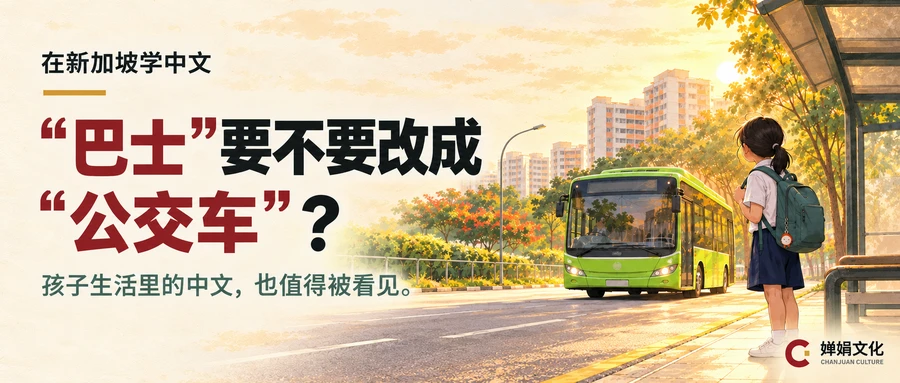
A child writes: “放学后,我搭巴士去图书馆。” — “After school, I took the bus to the library.”
Some parents immediately replace 巴士 with 公交车, believing that the latter is the more correct expression. But 巴士 belongs to the Chinese that children hear and use in Singapore. Singapore’s public transport materials also use terms such as 巴士站 and 接驳巴士.
The useful lesson is not that one region always has the correct word. It is that the same thing can have different names in different places and for different readers.
Will the reader understand?
In a story about school life in Singapore, “搭巴士回家” is clear and natural. If the reader is less familiar with Singapore, a short explanation may help.
Does the expression fit the context?
A diary, story or conversation can preserve everyday local expressions. Writing for readers across regions may call for an explanation the first time a term appears.
“我们在巴士转换站,也就是公共汽车总站集合。” “We meet at the bus interchange — the bus terminal.”
Does the child know other ways to say it?
Keeping a local expression does not mean knowing only one expression. Knowing 巴士, 公交车 and 公共汽车 gives the learner more choices and helps them read texts from different places.
- 巴士: also 公交车 or 公共汽车.
- 德士: also 出租车 or 计程车.
- 组屋: Singapore public housing, commonly called HDB flats in English.
- 食阁: a dining space with multiple food stalls.
Try asking for two sentences: “In Singapore, we usually say 巴士.” Then: “For someone unfamiliar with Singapore, I can say 公共汽车 or explain what I mean.”
This is more than a vocabulary exercise. A learner is noticing how language changes with the place, audience and situation.
Shared language conventions help us communicate clearly. Regional expressions preserve everyday experience. Teaching Chinese can make room for both.
Know why you are saying it this way — and how you might say it for another reader.
Related resources
A specific question can tell us something about a learner’s starting point.
Discuss learning needs